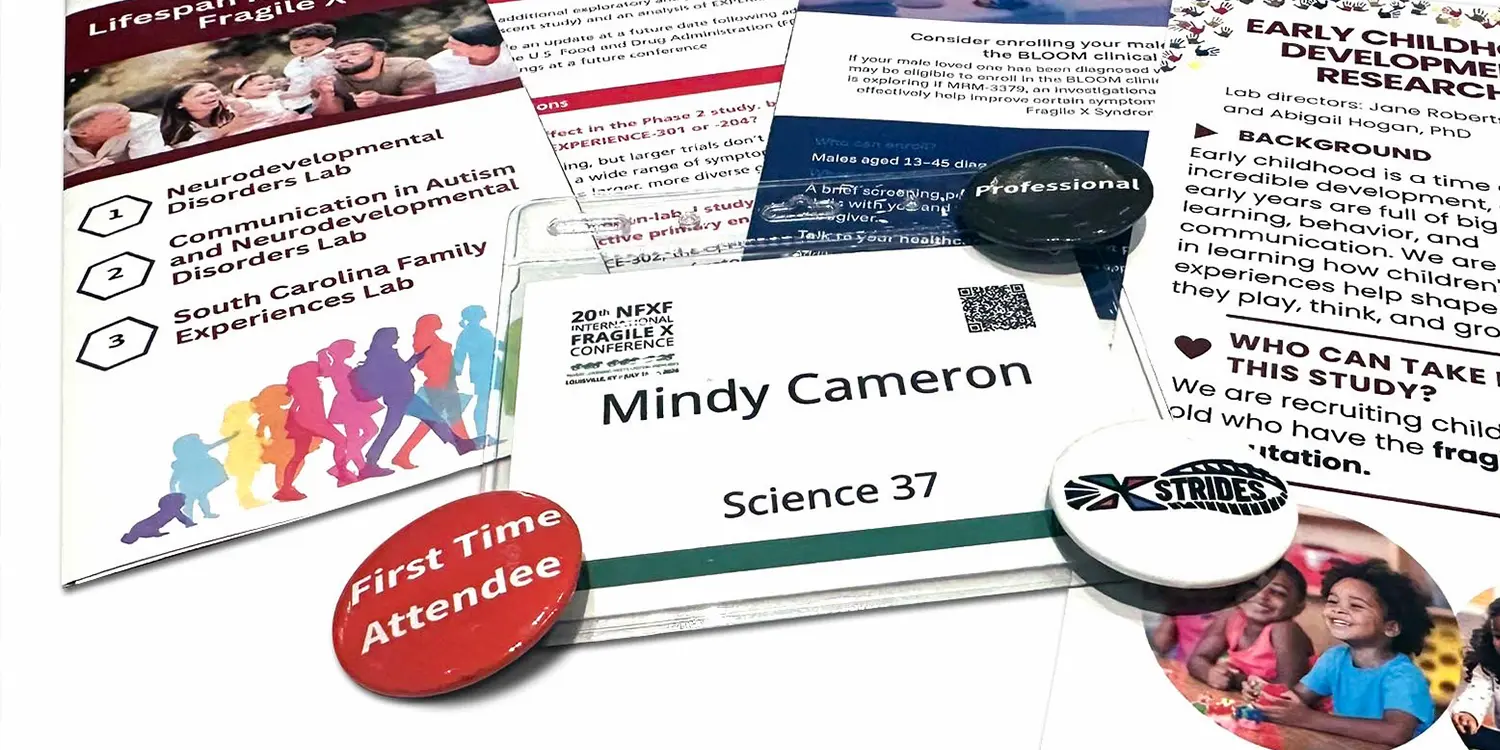
When I stepped into the host hotel for July’s International Fragile X Conference in Louisville, I immediately felt at home.
My 25-year-old son has a different X-linked genetic disorder, but the scene was deeply familiar: parents with young children, teenagers, and adult children mingling with some of the field’s leading physicians and researchers. It is something I have come to treasure about being part of a close-knit rare disease community.
Family conferences are among the few places where you can sit down with someone you have just met and begin talking from a place of shared understanding. There is less explaining. Less apologizing. Less need to translate a life that can be difficult for people outside the community to fully understand.
For a few days, some of the isolation that comes with a serious lifelong medical condition simply falls away. You are surrounded by people who get it.
There was another feeling at the Fragile X conference that was familiar to me from my Duchenne muscular dystrophy (DMD) community: the sense that something is changing.
A handful of pharmaceutical and biotechnology companies were at the conference, actively developing or evaluating potential therapies. It reminded me of where the DMD community was not very long ago.
Eleven years ago, there were no FDA-approved therapies for DMD. Today, there are eight approved therapeutics, with more than 75 companies conducting research, running clinical trials, or developing commercial products.
Progress in rare disease is never guaranteed, and it rarely happens as quickly as families would like. But I left Louisville with the sense that the Fragile X community may be approaching an important period of scientific progress of its own.
And that makes another question increasingly important: If more clinical trials are coming, how do we make it possible for more families to participate in them?
The hope was there and real. But so was the exhaustion underneath it.
Throughout the conference, in formal sessions and informal conversations with parents and family members, I was reminded of a reality that does not get discussed nearly enough.
Caregiving for someone with a serious lifelong health condition is exhausting.
It can be more than a full-time job, without guaranteed nights or weekends off. There may be no vacation and no retirement. Families are navigating medical appointments, therapies, school or adult services, insurance, transportation, behavioral needs, medications, and the countless logistics of everyday life.
At the same time, professional caregivers can be difficult to find, and families may have limited access to respite and other support services.
After 22 years working in rare disease, I have met relatively few patients and families who simply do not want to contribute to research. The willingness is often there.
The capacity may not be.
Traditional clinical trial participation can ask families to travel significant distances, disrupt carefully established routines, miss work, arrange care for other family members, and spend additional hours in unfamiliar healthcare environments. For individuals with neurocognitive conditions, those disruptions can be particularly difficult.
When a family is already stretched to its limit, even a trial they desperately want to participate in can become practically impossible.
That is not a lack of engagement. It is a trial-design problem.
This is one reason I attended the International Fragile X Conference in my role as patient advocacy lead at Science 37. Our Direct-to-Patient Site is built around a simple premise I believe in deeply: when appropriate, bring the clinical trial to the patient rather than requiring the patient to continually travel to the clinical trial.
For individuals with neurocognitive conditions, the home can offer an important advantage. Participants can remain in a familiar environment and maintain more of their established routines. For caregivers, conducting protocol-appropriate visits at home can reduce some of the travel, planning, time away from work, and logistical disruption associated with traditional site participation.
And we have seen what can happen when families are given that option.
In a recent Phase 3 Fragile X clinical trial, Science 37’s Direct-to-Patient Site enrolled 25% of the study’s participants as a single site and achieved a 94% retention rate.
Those numbers matter. But what they represent matters more.
They represent families who were able to participate in research and participants who were able to remain in a study. And they demonstrate what can happen when clinical research is designed not only around the requirements of a protocol, but also around the realities of the people being asked to participate in it.
I left Louisville excited about what may be ahead for the Fragile X community. Science is advancing. Companies are investing. Families are hopeful.
But better therapies require successful clinical trials, and those trials require patients and families who are able to participate and remain engaged.
As the science of rare disease moves forward, the way clinical research is delivered needs to evolve with it.
For Fragile X families, and for families living with countless other lifelong conditions, reducing the burden of participation is not simply about convenience. It can be the difference between wanting to participate in a clinical trial and actually being able to.
Bringing appropriate study visits into the home may not remove every barrier. But for some families, it can create the capacity to participate where willingness already exists.