
The word "innovation" gets used frequently in clinical research.
We often associate it with artificial intelligence, digital platforms, connected devices, decentralized technologies, and new data sources. While these advancements are important, one message was reinforced repeatedly during discussions at this year's SCRS West Innovation Summit:
Innovation only matters when it improves the experience of the people participating in and delivering clinical research.
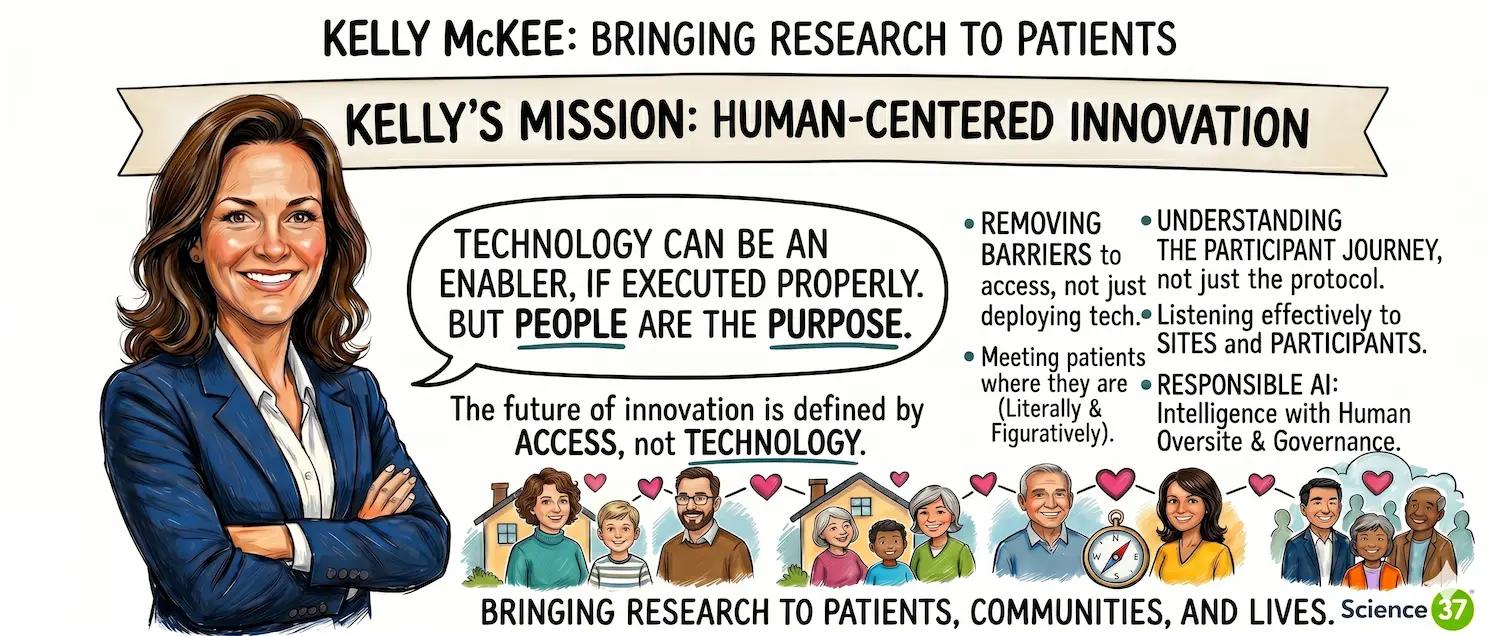
Technology can be an enabler (if executed properly). People are the purpose.
For years, the industry has focused on bringing patients to research. The next chapter of innovation is about bringing research to patients.
At Science 37, this principle has shaped our Direct-to-Patient model from the beginning. The goal was never simply to deploy technology. The goal was to remove barriers that prevent people from participating in clinical research.
Distance. Transportation. Work schedules. Caregiving responsibilities. Physical limitations. Geographic access.
These are not technology problems.
They are human problems.
And solving them requires reimagining how clinical trials are designed and delivered.
One of the most encouraging themes throughout SCRS West was the growing recognition that successful studies must fit into participants' lives rather than expecting participants to fit into study designs.
Whether the discussion centered on recruitment, retention, digital biomarkers, decentralized visits, or protocol execution, the underlying question was remarkably consistent:
How do we reduce burden while maintaining scientific rigor?
The answer rarely starts with technology.
It starts with understanding the participant journey.
When we ask participants to travel long distances, miss work, arrange childcare, or navigate complicated study procedures, we create unnecessary barriers to participation. As an industry, we have an opportunity to rethink those assumptions.
The future of research will be defined by our ability to meet participants where they are, both literally and figuratively.
Another theme that emerged was the importance of involving sites earlier in study design.
During a workshop sponsored by Sanofi and focused on digital biomarkers and study implementation, I joined other site professionals to provide candid feedback on participant-facing materials, operational workflows, and protocol execution considerations.
The exercise served as an important reminder: what appears straightforward in a protocol often becomes significantly more complex during execution.
Sites understand where participants struggle. They understand where operational friction exists. They understand where burden accumulates.
When sponsors engage sites early, they gain access to insights that can improve study feasibility, participant experience, and overall execution.
Innovation is not always about introducing something new. Sometimes it is about listening more effectively to the people closest to the work.
Artificial intelligence was another frequent topic throughout the conference.
The conversation has matured significantly over the past year. The question is no longer whether AI has a place in clinical research. It clearly does.
The more important discussion is how to implement AI responsibly.
Across sponsors and sites, there appears to be growing alignment that AI can improve efficiency, support content development, reduce administrative burden, and accelerate workflows. At the same time, there is broad agreement that governance matters.
Appropriate SOPs. Defined review processes. Human oversight. Accountability.
These are not barriers to AI adoption. They are prerequisites for responsible adoption.
AI can help us work smarter, but it cannot replace the expertise, judgment, and empathy required to care for participants and execute high-quality research.
As an industry, we should continue embracing new technologies, new data sources, and new operational models.
But we should also remember that technology itself is not the innovation.
The innovation is creating clinical research that is more accessible.
More inclusive.
More convenient.
More representative of the populations we hope to serve.
Whether that is accomplished through decentralized visits, mobile research, digital tools, artificial intelligence, or entirely new approaches, the objective remains the same: make it easier for people to participate in research.
Because the most meaningful innovations in clinical research are not the ones that change technology.
They are the ones that change access.
And ultimately, access is what brings clinical research to more patients, more communities, and more lives.