When my son Christopher was diagnosed with Duchenne muscular dystrophy as a toddler, safety took on an entirely different meaning for our family.
Duchenne is a progressive disease. Things change. New symptoms emerge. Medications change. Abilities change. And as a parent, you learn to pay very close attention to all of it.
That vigilance follows families into clinical research, too.
For more than two decades, as Christopher’s mother and as an advocate for families living with neuromuscular diseases, I’ve seen how much trust patients and caregivers place in the people running clinical trials. We trust them to monitor lab values, cardiac signals, and adverse events. But we also trust them to listen when something changes and we don't know what it means.
That’s why, on World Patient Safety Day, I’ve been thinking about what it really means for someone living with a chronic, progressive disease to feel safe in a clinical trial.
For me, it starts with a simple idea: safety has to extend beyond the individual visit.
September 17 is World Patient Safety Day and the World Health Organization’s (WHO) 2026 campaign focuses on “Safe care for noncommunicable diseases,” with the slogan “Safe care for life!” The campaign highlights something families living with chronic conditions know well: managing an NCD is not a single encounter with the healthcare system. Care can stretch across years, providers, and settings, creating new safety considerations along the way.
The WHO is also emphasizing the importance of engaging people living with NCDs as partners in their own safety and in shaping safer care.
That message resonates with me.
For families living with Duchenne, safety isn't something we think about only when we walk into a doctor's office. It is part of everyday life. We are constantly watching for changes, managing medications, tracking symptoms and trying to understand what is normal, what is new, and what needs attention.
Clinical research becomes part of that same journey.
When a child or adult with a progressive disease participates in a trial, sponsors and research teams have a responsibility to monitor for potential harm, identify safety signals and respond appropriately when adverse events arise. But participants and caregivers also need to know how to raise concerns and where to turn when something changes.
That connection between the research team and the participant matters.
When trial check-ins occur weeks or months apart, families may have questions or concerns between visits.
If a new symptom emerges on day three of a multi-week gap, a parent may wonder: Is this expected? Should I call someone? Does this need immediate attention?
That uncertainty can be difficult to carry.
For me, patient-centered safety means making sure participants and caregivers have accessible ways to communicate concerns and receive appropriate guidance when something changes. It means recognizing that the person participating in a trial is not simply showing up for scheduled assessments. They are living with their condition every day.
This is particularly important for people with progressive diseases, where changes in health, mobility, and symptoms can happen over time.
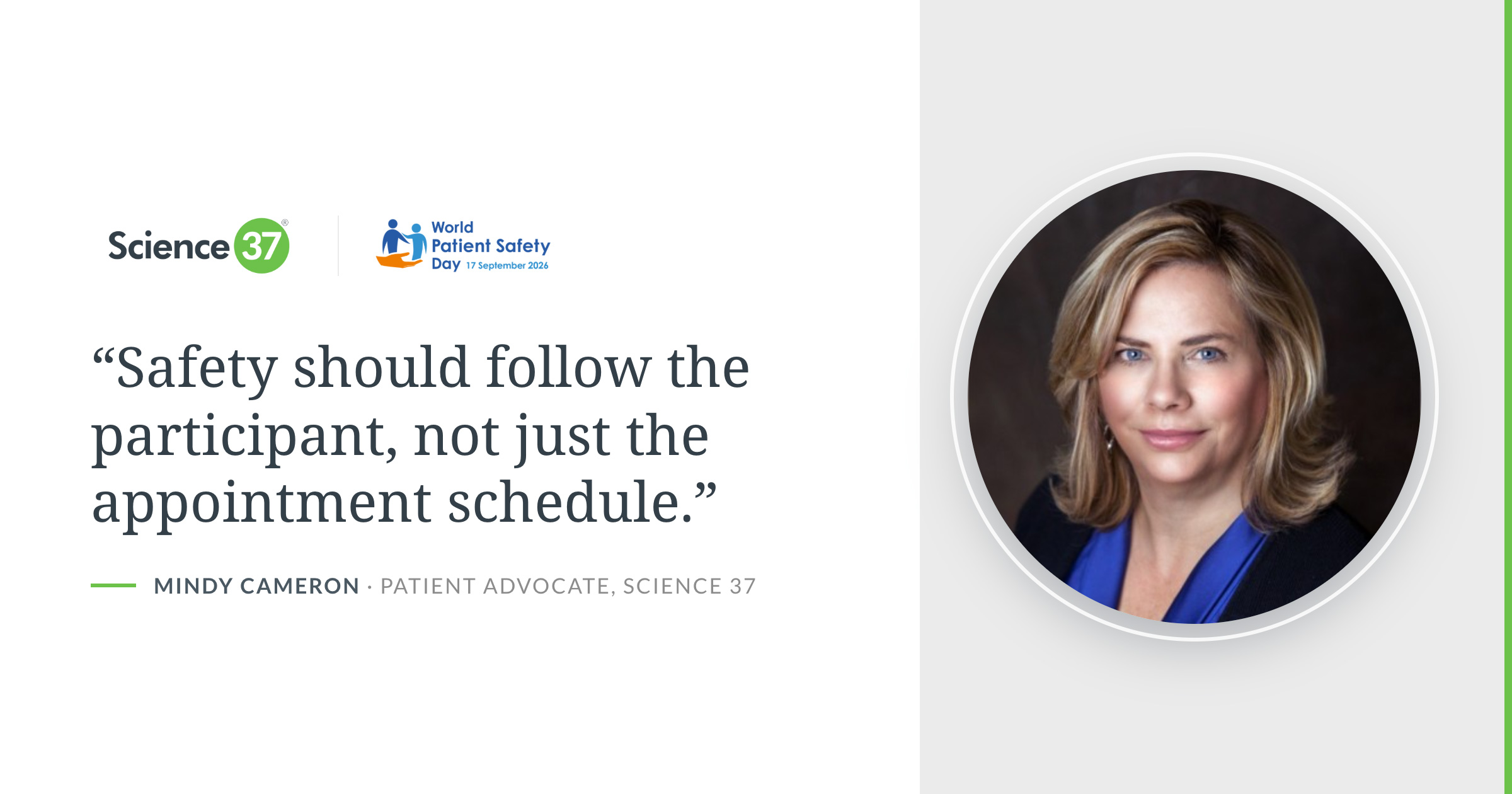
Safety should follow the participant, not just the appointment schedule.
This is one reason I believe direct-to-patient research has an important role to play.
When research visits take place in the home, participants can complete study-related assessments without the physical and logistical burden of traveling to a research site. For people living with significant mobility limitations or progressive illness, that can make participation more feasible while allowing research teams to maintain regular contact with participants.
Home visits, electronic diaries, and other connected tools can also create additional opportunities for research teams to identify changes and respond through the appropriate clinical and study processes.
The goal isn't to replace rigorous safety monitoring. It is to make that monitoring more accessible within the realities of participants' lives.
And that is closely aligned with this year's World Patient Safety Day message. WHO emphasizes that safety risks for people living with NCDs can arise across the continuum of care and in everyday settings, including homes and communities.
For people living with chronic conditions, the home is not separate from their health journey. It is where much of that journey happens.
My experience with Duchenne has also taught me that patients and caregivers have something important to contribute to the conversation about safety.
We know what changes look like in everyday life. We know which challenges can make participation harder. And we know what it feels like to wait for an answer when something doesn't seem right.
That lived experience should be part of how clinical research is designed and delivered.
At Science 37, I've seen firsthand how a direct-to-patient research model brings research closer to participants while maintaining rigorous clinical and safety oversight. Research nurses can conduct study-related visits in patients' homes, while investigators maintain appropriate medical oversight throughout the study.
For participants and caregivers, that can mean less travel and greater access to the research team within the realities of everyday life. For sponsors, it provides another way to support study execution and ongoing safety oversight.
On World Patient Safety Day, I'm reminded that keeping people safe in clinical research is about more than what happens during a scheduled visit.
It’s about making sure safety remains part of the journey, wherever that journey takes place.
After more than two decades of living alongside Duchenne, I know how much that can mean.